
Small Business SEO Services: What's Included and What They Cost in 2026
Affiliate Disclosure: This page contains affiliate links. If you purchase through our links, we may earn a commission at no extra cost to you. This helps us keep creating free content. Learn more
Small Business SEO Services: What They Should Include, Month by Month — and What They Really Cost
Small business SEO services are a monthly bundle of four kinds of work — technical fixes, local profile management, content, and links — and in 2026 a small business should expect to pay roughly $500 to $2,000 a month for local-focused SEO, or $2,500+ a month for national campaigns. The problem is that most pages ranking for this term are agency directories ("best SEO companies") that never tell you what you're actually buying. This guide does the opposite: it walks through what a competent provider does month by month, what each budget tier realistically buys in working hours, and the red flags that separate real operators from invoice factories.
Key Takeaways
- Good small business SEO services bundle four workstreams: technical fixes, local visibility (Google Business Profile), content, and links — not one of them alone.
- If you serve a geographic area, local SEO comes first: Google's own research found 76% of people who search for something nearby on a smartphone visit a business within 24 hours, and 28% of those searches end in a purchase.
- For most small businesses, $500/month buys minimal maintenance, $1,000/month is the realistic starting point for competitive growth, and $2,000/month supports content plus link building.
- Judge providers by deliverables and hours, not dashboards: a credible retainer states what gets done each month and reports movement in rankings, leads, and calls.
What Are Small Business SEO Services, Exactly?
Small business SEO services are ongoing work that makes your site and your business profiles easier for search engines to understand and easier for customers to find. The word to hold onto is services — plural. A retainer that only touches one part of the system (say, writing blog posts, or only "optimizing" your meta tags) is not full-stack SEO, and results stall because rankings depend on all four layers working together.
The four layers:
- Technical SEO — crawl errors, page speed, mobile usability, broken links, duplicate content, index coverage, structured data. This is the foundation; nothing else compounds if search engines can't reliably crawl and render your pages.
- Local visibility — your Google Business Profile (name, categories, hours, services, photos, Q&A), review generation and responses, and citations (consistent business listings across directories). For local businesses this layer often drives more calls than the website does.
- Content — service pages targeting the keywords your customers actually search, plus supporting articles that answer the questions they ask before buying. This is where the monthly content hours go.
- Authority (links and mentions) — earning references from local news, chambers of commerce, industry directories, and partners so search engines trust you enough to rank you.
Any provider you talk to should be able to show you, in plain language, how their monthly retainer covers all four. If they can only describe one, you've found a specialist — which is fine, but price it as one.
Local or National SEO: Which Do You Actually Need?
If customers come to you — or you go to them — within a defined area, you need local SEO first, and it behaves differently from national SEO. Local searchers are closer to buying than almost any other traffic source. Google's consumer research with Ipsos found that 76% of people who search for something nearby on a smartphone visit a related business within 24 hours, and 28% of those searches end in a purchase (Google / Think with Google, retrieved 2026-10-16). That's why the local layer — profile, reviews, map pack placement — usually pays back faster than blog content ever will.
The decision framework:
- You serve a city or region (home care, home health, clinics, therapy practices, home services): invest 60–70% of the budget in the local layer and location-specific service pages. Your "rankings" are the map pack and localized results, not ten blue links.
- You sell to anyone anywhere (e-commerce, SaaS, national B2B): local still matters for brand trust, but your budget shifts toward content and links, because you're competing on topical authority, not proximity.
- Both (a regional chain, or a service business expanding to new cities): run a location-page template plus a per-city citation and review cadence — this is where most small businesses under-invest.
A useful gut check: search your main service plus your city on your phone. If a map pack appears at the top, you're in local territory, and your Google Business Profile is your most valuable marketing asset. We work in one industry — home health and home care agencies — and we apply this same local-first framework to home health and home care marketing.
What Good SEO Work Looks Like, Month by Month
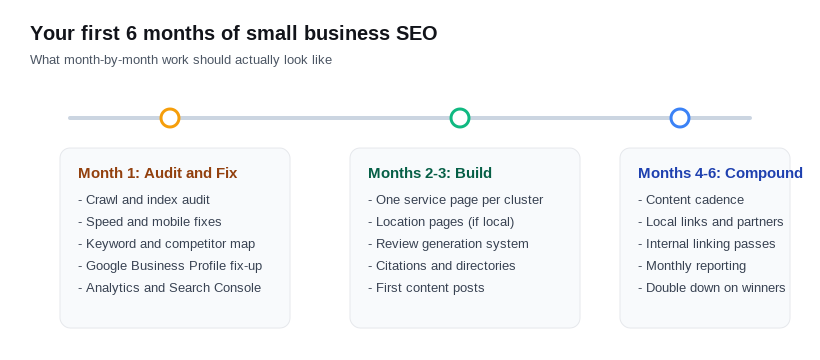
The biggest complaint about SEO is that it's opaque: "trust us, it takes time." A competent provider removes the fog by mapping work to a visible timeline. Here's the shape of a healthy first six months:
Month 1 — Audit and fix. A full technical crawl, a keyword and competitor map, a Google Business Profile cleanup (categories, services, photos, hours), and analytics plus Search Console properly wired up. If your site has crawl errors, thin pages, or a slow mobile experience, this is the month it gets found and queued.
Months 2–3 — Build. One well-built service page per keyword cluster, location pages if you serve multiple areas, a review generation system (asking every happy customer, not just the angry ones), citation cleanup on major directories, and the first supporting content posts.
Months 4–6 — Compound. A steady content cadence, local link earning (sponsors, partnerships, local press), internal linking passes so authority flows to your money pages, and monthly reporting you can actually read. By now the provider should be doubling down on what's working and killing what isn't.
From month four onward, ask to see the delta: rankings that moved, pages that gained traffic, calls and form fills attributed to search. Rankings-only reporting is a warning sign, because a ranking you can't trace to a phone call is trivia.
What Small Business SEO Should Cost in 2026
Pricing is where most ranking pages for this topic go silent, so here are real numbers. Current 2026 pricing guides converge on the same ranges: monthly retainers average roughly $2,500–$3,500 across all business sizes (Boulder SEO Marketing, 2026), but small businesses focused on local results typically land in the $500–$2,000/month band (Arc4, 2026), with hourly consulting running $100–$300 and one-time projects from $5,000 to $30,000 depending on site size and market competition.
What those tiers actually buy, in working hours:
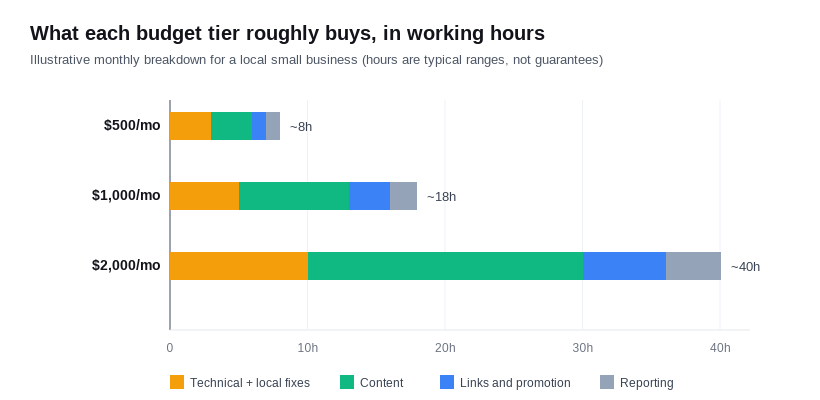
- $500/month (~8 hours). Maintenance only: profile updates, a small fix batch, a report. Enough to keep a strong position from decaying — not enough to climb a competitive SERP. If you're paying $500 and were promised page one, the math never supported the promise.
- $1,000/month (~18 hours). The realistic starting point for growth in a moderately competitive local market: one substantial content piece plus service-page improvements, ongoing profile and citation work, and technical upkeep.
- $2,000/month (~40 hours). Supports a genuine content engine plus link earning — this is the tier where national or multi-location ambitions become realistic.
Two things inflate quotes legitimately: competitive markets (personal injury law, divorce attorneys) and multi-location footprints, which multiply the local layer. Two things should make you walk away: contracts longer than six months before any results review, and pricing that can't be explained in hours and deliverables.
Red Flags When Comparing Providers
Before comparing agencies, eliminate anyone showing these behaviors — they predict churn, penalties, or both:
- Guaranteed rankings or a guaranteed timeframe. No one controls Google's algorithm; guarantees are either naive or a setup for low-value keywords you'd rank for anyway.
- Proprietary dashboards instead of plain deliverables. You should receive a monthly list: what was built, fixed, and earned — plus the numbers behind it.
- "We'll submit your site to hundreds of directories." Bulk low-quality citations are a 2012 tactic that now adds cleanup cost later.
- No access to your own accounts. Your Google Business Profile, Search Console, and analytics must be owned by you from day one.
- Priced too cheap to be real. Under about $500/month, the retainer mostly covers a report, not the research, content, and technical work that moves rankings (Built Right Digital, 2026).
How to Choose a Small Business SEO Provider
With the red flags filtered out, use a three-pass process:
- Shortlist on review platforms, not ad results. Cross-reference the vetted lists on Clutch's small business SEO firms directory, the SEO.com small business companies list, and the redseo.io small business agency comparison — three independent sources, and note which providers appear on several.
- Demand a sample work plan. A serious provider will sketch your first 90 days (audit → build → report) before you sign. If their proposal is pricing tiers with vague labels, keep shopping.
- Ask for one local case study with numbers. A similar-size business, similar market, with before/after rankings, traffic, and leads — not just logos.
One more filter that saves small businesses real money: check whether you need full-service SEO at all. If your bottleneck is a slow, outdated, or unlaunchable website, no amount of monthly SEO fixes a bad foundation — our web design services cover that rebuild path, and our IT audits catch the technical issues that quietly cap every SEO effort.
Frequently Asked Questions
How long does small business SEO take to work?
Expect early movement (profile impressions, map pack entries for long-tail terms) within 60–90 days, and meaningful ranking and lead movement in 4–6 months for competitive local terms. Anyone promising month-one page-one results is selling the keyword you already rank for.
Is SEO worth it for a very small business?
If customers in your area search for what you sell, yes — local search converts at retail speed, and the local layer (Google Business Profile, reviews, citations) is the highest-leverage spend for a tiny budget. Start there before buying blog content.
Can I do SEO myself instead of hiring?
You can handle the local layer yourself — a well-managed Google Business Profile with photos earns 42% more direction requests and 35% more clicks to the website than profiles without them (Google Small Business Bulletin, July 2025). The case for hiring is bandwidth: technical audits, content production, and link earning each consume 5–20 hours a month that most owners don't have.
What's the difference between SEO and Google Ads?
Ads rent visibility: traffic stops the day you stop paying. SEO builds an asset that compounds — but it needs months to mature. Most small businesses run both: ads for immediate lead flow while SEO builds the durable layer underneath.
The Bottom Line
Small business SEO services aren't a mystery product — they're a defined bundle of technical fixes, local profile work, content, and links, priced roughly $500–$2,000 a month for local businesses and best judged by hours and deliverables rather than dashboards. Demand a month-by-month plan, verify pricing in working hours, and start with the local layer if you serve a geographic area. When you're ready to pair search visibility with the rest of your digital presence, our services overview shows how the pieces fit together — and our pricing page applies the same transparency standard to our own work that this article asks you to demand from anyone.
Want these results for your SEO & Marketing?
We build custom AI agents and workflow automations tailored to your exact operations. Stop losing money to manual work.