
Website Design Cost for Small Business in 2026: A Line-Item Breakdown
Affiliate Disclosure: This page contains affiliate links. If you purchase through our links, we may earn a commission at no extra cost to you. This helps us keep creating free content. Learn more
Website Design Cost for Small Business in 2026: A Line-Item Breakdown
Website design cost for small business in 2026 lands between $200 and $35,000 depending on who builds it — but the number most small businesses actually pay for a professional custom build is $4,000 to $12,000, with a published median of $7,000. DIY website builders run $15–$50 per month plus your time; freelancers charge $2,000–$8,000 for a small business site; agencies quote $10,000–$35,000. On top of every build, plan for $30–$250 per month in recurring costs that most ranking pages never mention.
Those ranges are so wide because the pages ranking for this question hedge. They quote "it depends," stack three vague tables on top of each other, and skip the recurring costs entirely. This guide does the opposite: it breaks a real budget down line by line, gives you a five-tier cost table you can locate yourself in, prices the hidden fees, and hands you a decision framework for DIY versus hiring based on what you can actually spend.
Key Takeaways
- A professional custom small business website costs a median of $7,000 (published range $4,000–$18,000) according to an August 2026 pricing census of US providers.
- Line items, not vague "design fees": a typical $7,000 build spends roughly 34% on design, 23% on front-end build, 17% on copywriting, and the rest on CMS setup, imagery, and QA.
- Recurring costs are the real budget killer: maintenance care plans ($30–$250/month), hosting, domains, and licensed imagery add $500–$3,000+ per year on top of the build.
- DIY builders cost $125–$600 in year one but consume 40–80 hours of your own time — at $50/hour of your own labor, "free" DIY costs more than a template freelancer.
- If a quote won't show you line items, the number is hiding something: 79% of agencies publish no prices at all.
What a Small Business Website Actually Costs in 2026
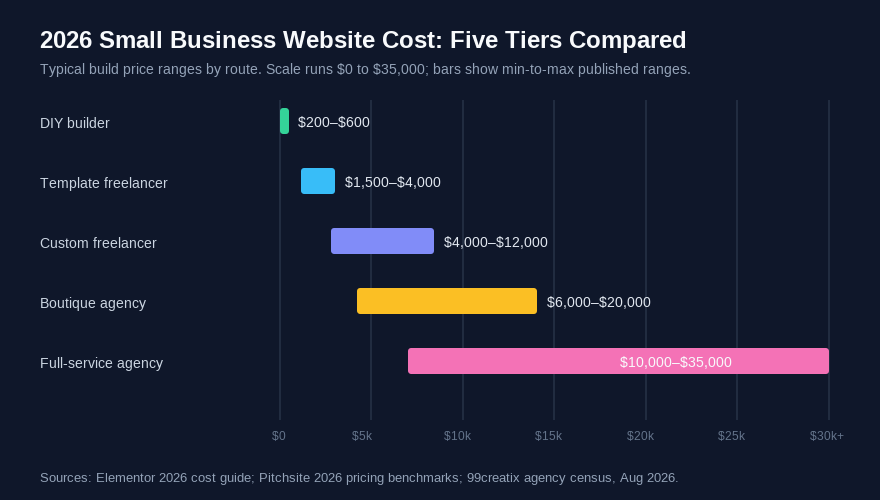
Start with the route, because the route sets the number more than anything else about your business does. A census of providers that publish real price lists — 34 US and international studios, sampled August 30, 2026 — put the median custom small-business website at $7,000, with individual quotes running from $4,000 to $18,000 (99creatix, retrieved 2026-10-19). Basic one-page brochure builds median around $799.
The other benchmarks triangulate the same picture:
- DIY website builders (Wix, Squarespace, WordPress.com): $15–$50/month on a business-capable plan, or $125–$600 in year one including first-year domain and subscription quirks.
- Freelancers: $2,000–$8,000 for a professional custom build, with hourly rates of $75–$150 (Elementor's 2026 cost guide). Junior freelancers start near $1,500; senior specialists reach $12,000.
- Agencies: $10,000–$35,000 for a typical small business site; complex e-commerce starts around $20,000 and climbs from there.
One number worth holding onto: when Clutch research asked who small businesses actually hire, 59% chose freelancers and 41% chose agencies. The freelancer route isn't the budget fallback — it's what most businesses pick, and at 50–70% below agency pricing for equivalent 5-page sites, the math explains why.
Cross-check these bands against two other current guides — Oui Digital's website cost breakdown and Sprout Sage Solutions' small business web design cost guide — and they land in the same territory: builders at the bottom, freelancers in the middle, agencies at the top. When independent sources converge, you can quote against the range with confidence.
The Line-Item Breakdown: Where Every Dollar Goes
A quote that says "$7,000 for design and development" tells you nothing. Here is what that same $7,000 looks like when a builder actually prices the work, line by line:
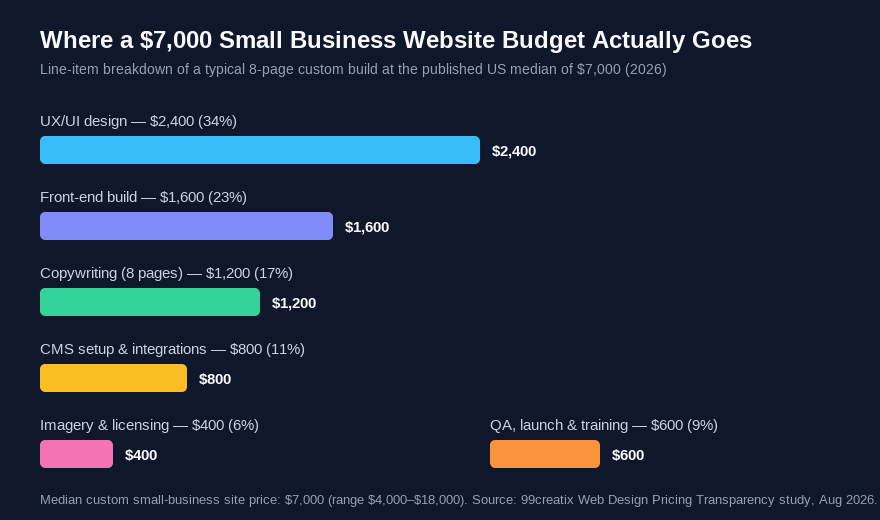
UX/UI design — $2,400 (34%). Sitemaps, wireframes, and the actual visual design of every page template. This is the largest line because it's the one you see: everything the visitor experiences gets designed here, desktop and mobile.
Front-end build — $1,600 (23%). Turning approved designs into a working, responsive site. On WordPress, Webflow, or a similar CMS this includes theme customization or component building, mobile breakpoint tuning, and accessibility fixes.
Copywriting — $1,200 (17%). Eight pages of professional copy at $100–$250 per page. This is the line most DIY owners skip and most regret skipping: design sells the click, copy sells the call. If you write your own copy, a good builder credits this line back — or you can reallocate it to more pages.
CMS setup and integrations — $800 (11%). Installing and configuring the content management system, connecting your contact forms to email or CRM, Google Analytics 4, and any booking or payment tools.
Imagery and licensing — $400 (6%). Licensed stock photography, icon sets, or graphics. Custom photography runs higher; this line assumes premium stock. This is one of the hidden costs people discover later — more on that below.
QA, launch, and training — $600 (9%). Cross-browser testing, speed optimization, redirects from your old site, DNS cutover, and an hour of training so your team can edit pages without calling the builder.
Use this structure to interrogate any quote. Ask what the design line covers (how many unique templates?), what the copy line assumes (who writes it, how many rounds of revision?), and what happens after launch. A quote with only two lines — "design" and "development" — is where scope-creep invoices come from.
The 2026 Cost Table: Find Your Tier
Locate yourself in one of five tiers, then sanity-check every quote against the range:
| Tier | Route | 2026 build price | You get | Best for | |------|-------|------------------|---------|----------| | 1 | DIY builder | $200–$600/yr | Template you fill in yourself | Solo operator, time-rich, simple site | | 2 | Template freelancer | $1,500–$4,000 | Premium template customized with your brand | First professional site, tight budget | | 3 | Custom freelancer | $4,000–$12,000 | Custom design, CMS, 5–10 pages, basic SEO | Established small business, 5–20 staff | | 4 | Boutique agency | $6,000–$20,000 | Strategy + custom design + copy + support | Growing businesses, lead generation focus | | 5 | Full-service agency | $10,000–$35,000+ | Full team, e-commerce, CRO, ongoing retainer | Complex builds, regulated industries, stores |
Two things this table should tell you. First, tiers 2 and 3 overlap agency tier 4 — a senior freelancer routinely out-delivers a boutique agency at the same price because there's no account-manager overhead. Second, if a "small business" quote arrives above $20,000 for a non-e-commerce site, you're paying for tier-5 positioning; either the scope genuinely needs it or you should get a second quote.
Pitchsite's 2026 pricing benchmarks draw the same tier lines from agency-side data and add useful detail on payment structure: the standard is 50% upfront, 25% at design approval, 25% at launch. Any request for 100% upfront is a red flag regardless of tier.
DIY vs Hire: A Decision Framework by Budget
The right answer depends less on money than on whose hours you're spending. Price your own time honestly — if you bill $75/hour doing client work or running operations, a "free" DIY site that eats 60 evenings is a $4,500 website you built slowly and without a designer's eye.
Choose DIY (Tier 1) when all three hold: your site is 5 pages or fewer, nothing on it transacts, and you genuinely enjoy or tolerate layout work. A service business taking bookings can run fine on a $25/month builder plan. Year-one cost including domain: $125–$600. The tradeoff is permanent: you are now the web team, forever.
Choose a template freelancer (Tier 2) when you need professional credibility fast. A premium template customized with your brand, copy you write from their interview, and a proper domain and email setup runs $1,500–$4,000. This is the highest-value tier for businesses under about $500K revenue that just need to look legitimate and rank locally.
Choose a custom freelancer (Tier 3) when your site has to earn money. If the website is your lead engine — service pages targeting specific searches, a blog, conversion tracking — custom design and on-page SEO foundation pay for themselves in a handful of extra clients per year. Our web design services start from this tier's scope because it's where the ROI crossover happens for most small businesses.
Choose an agency (Tiers 4–5) when the project needs three or more specialists at once — designer, developer, copywriter, SEO, plus project management — or when e-commerce with real order volume is involved. You're paying for coordination and continuity, not better pixels.
The decision test in one sentence: if the website is a brochure, DIY or Tier 2; if it's a channel that produces customers, Tier 3 or above.
The Hidden Costs Ranking Pages Omit
The build price is the opening bid. Here is what the site actually costs to keep, none of which shows up in most cost guides:
Maintenance and care plans — $30–$250/month. Updates, backups, security monitoring, and small edits. WordPress care plans publish at a median of $89/month (99creatix); small business site maintenance is commonly quoted at $30–$250/month, with annual totals of $600–$6,000 depending on who you ask and how much support is bundled. Unmaintained WordPress sites get hacked — the cheap years become an expensive emergency rebuild.
SSL certificates — $0 to $250/year. Most hosts now include Let's Encrypt certificates free, but standalone certificates range from $8 to $250 per year when they don't (jim.com cost guide). Check before you compare hosting prices — it's a real line item on some plans.
Imagery licensing — $0 to $500+/year. That $400 build line covers launch. If you publish monthly content (you should), every new post needs licensed images, or a subscription like a stock plan, or your own photography. Sites that hotlink "found" images collect takedown invoices in the hundreds of dollars per image.
Premium plugins and tools — $100–$600/year. Forms, SEO plugins, booking systems, and page builders increasingly run on annual licenses. A WordPress site with four premium plugins carries $200–$400/year in renewals that never appear in the build quote.
SEO — optional but the biggest swing. Entry-tier SEO retainers publish at a median of $2,200/month, with entry tiers from $1,000 (99creatix). You don't need that on day one — a proper on-page foundation at build time, then $750–$1,500/month local SEO for competitive markets, is the realistic small business pattern.
Domain and email — $50–$150/year. Domain renewal, professional email hosting, and — if you rebrand later — a new domain plus redirects.
Add it up and the recurring bill for a professionally built site runs roughly $500–$3,000+ per year — $10–25% of the build price, annually, forever. Budget for it upfront or the site silently decays by year two.
Year-One Total Cost: Two Worked Examples
Example 1: Template freelancer, service business (6 pages). Build: $2,500. Care plan: $89/month × 12 = $1,068. Domain and email: $120. Imagery: included in build. Year-one total: $3,688. Years two onward: about $1,190.
Example 2: Custom freelancer build with SEO foundation (10 pages). Build: $7,000. Care plan: $150/month × 12 = $1,800. Licensed imagery subscription: $300. Domain and email: $120. Year-one total: $9,220. Years two onward: about $2,220.
The pattern in both: the recurring line is 20–30% of the build in year one and then becomes the entire cost of ownership. Whoever owns your maintenance owns your uptime, your security, and your ability to change anything — which is why the maintenance line deserves as much scrutiny as the design line. If you want a second opinion on a quote's recurring line, our pricing page shows how we structure build-versus-care-plan costs, and our services overview maps which tier of engagement fits which business size.
Frequently Asked Questions
How much should a small business pay for a website in 2026?
For a professional site that generates leads, budget $4,000–$12,000 for the build plus $500–$2,200 per year in recurring costs. Below $2,000 you're in template territory — fine for a brochure site, risky for a lead engine. Above $20,000 for a non-e-commerce site, get a second quote.
Is a $500 website worth it?
Sometimes — for a one-page site with your hours, services, and a contact form. What $500 never buys is custom design, professional copy, or SEO foundation. If the website needs to rank and convert, a $500 build usually gets rebuilt within two years, which makes it more expensive than doing Tier 2 or 3 once.
Why do agencies charge $10,000+ for the same 5 pages?
Team overhead, process, and continuity: a project manager, structured revisions, documentation, and a firm that still exists in three years to fix it. Roughly 41% of small businesses choose agencies for exactly those reasons. If you don't need coordination across specialists, a freelancer delivers equivalent output for 50–70% less.
What's the cheapest way to get a professional-looking website?
A premium template on a self-serve platform customized by a freelancer ($1,500–$4,000), with your own copy written from a structured interview. That combination gets you 80% of a custom build's credibility for 30% of the price.
The Bottom Line
Price the route, not the dream. Most small businesses should anchor on $4,000–$12,000 for a custom build, demand the quote broken into line items, and budget $500–$3,000 per year for the maintenance, licensing, and hosting that keep the site alive after launch. Do that, and the website becomes a measurable asset instead of a mystery invoice. The single next step that saves the most money: before you take any call, write down your five pages, who writes the copy, and who maintains the site — then ask each bidder to price exactly that.
Want these results for your Web Design?
We build custom AI agents and workflow automations tailored to your exact operations. Stop losing money to manual work.