
Digital Marketing Agency Pricing in 2026: What $500, $2,000, and $5,000 a Month Actually Buy
Affiliate Disclosure: This page contains affiliate links. If you purchase through our links, we may earn a commission at no extra cost to you. This helps us keep creating free content. Learn more
Digital Marketing Agency Pricing in 2026: What $500, $2,000, and $5,000 a Month Actually Buy
Digital marketing agency pricing for a real, ongoing engagement runs $1,000 to $10,000 per month for most small-to-mid-market businesses in 2026 — and the quote on the proposal is almost never the whole bill. Single-channel programs (SEO or paid ads or social) sit between $1,000 and $3,000 a month; multi-channel programs start around $3,500 and climb fast (Scopic Studios, retrieved 2026-10-21). On the hourly side, US agencies charge $100–$149 per hour, and paid advertising comes with a second bill: a management fee of 10–20% of your ad spend, on top of the spend itself.
The honest problem with most pages on this topic is that they hedge. "It depends" everywhere, three vague tables stacked on each other, and no mention of the platform fees, tool costs, and media minimums that arrive after you sign. This guide does the opposite. You get the retainer tiers decoded — what you actually receive at $500, $2,000, and $5,000 a month — a consolidated hourly-rate benchmark table from Clutch, DesignRush, and Promethean Research, the hidden line items that inflate the average engagement by 30–50%, and the five pricing tactics that should end a sales call.
Key Takeaways
- Most small-to-mid businesses pay $1,500–$10,000/month for an agency retainer; single-channel work runs $1,000–$3,000, multi-channel starts near $3,500 (Scopic, 2026).
- US agencies charge $100–$149/hour (Clutch, 100,000+ firms surveyed); the single most common rate band globally is $25–$49/hour.
- $500/month buys a contractor or a narrow task package — not an agency. A genuine $2,000/month retainer covers one channel properly; $5,000 covers two to three channels with strategy and reporting.
- Budget 10–20% of ad spend as a management fee on top of any retainer, plus $300–$1,500/year in tools the agency usually bills through.
- Red flags: first-month teaser pricing, 12-month lock-ins with no pilot, "100% upfront" retainers, and quotes that won't show deliverables.
The 2026 Benchmark Numbers, From First-Party Sources
Start with the data, because almost every quote you receive will be defensible or indefensible against it. These are consolidated from the largest first-party datasets available in 2026:
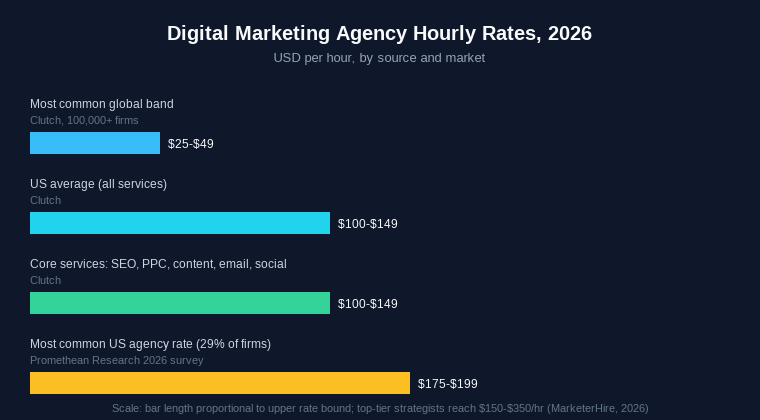
| Benchmark | 2026 figure | Source | |---|---|---| | Monthly retainer, most agencies | $5,000–$50,000/month (full range, all market sizes) | Clutch, 100,000+ firms | | Small-to-mid-market retainers | $1,500–$10,000/month | Scopic Studios | | Small business single-channel | $1,000–$3,000/month | Scopic Studios | | Small business multi-channel | $3,500–$5,000+/month | Scopic Studios | | Global hourly rates | $75–$400/hour; retainers $800–$20,000+/month | DesignRush | | Most common global hourly band | $25–$49/hour | Clutch | | US average hourly rate | $100–$149/hour | Clutch | | Core service hourly (SEO, PPC, content, email, social) | $100–$149/hour | Clutch | | US agency rate distribution | 29% of agencies charge $175–$199/hour | Promethean Research 2026 survey, via Anderson Collaborative | | Top-tier / senior strategists | $150–$350/hour | MarketerHire 2026 analysis |
Three things this table should tell you before you take a single sales call. First, the global $25–$49 band and the US $100–$149 band describe different markets — a quote near $35/hour almost always means offshore delivery, which can be perfectly good or a mismatch for a US-audience brand. Second, 29% of US agencies clustering at $175–$199/hour means a "premium" hourly rate is actually the market norm for mid-size US firms, not an outlier to negotiate down. Third, any small-business quote above $10,000/month needs a channel-by-channel justification — that's mid-market territory.
What $500, $2,000, and $5,000 a Month Actually Buy
The retainer tiers matter more than the averages, because the averages describe everyone and you need to locate yourself. Here is what each price point realistically gets you in 2026:
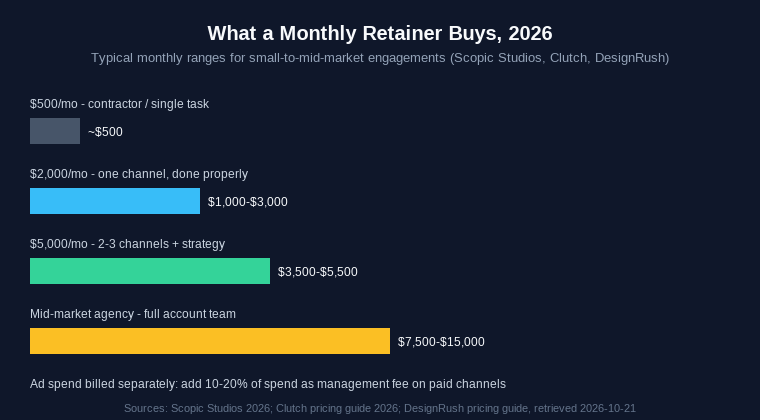
$500/month — a contractor, not an agency. At this level you're buying a single specialist's part-time attention: one blog post a week, an ad account audit, or basic Google Business Profile upkeep. Clutch's pricing data puts most full agencies' minimum engagements well above this — agencies listing "Under $1,000" project minimums are typically one-person shops or offshore teams. If you're quoted $500/month for "full digital marketing," you're being sold the teaser (see red flags below). This tier makes sense for a solo operator with one narrow, well-defined task.
$2,000/month — one channel, done properly. This is the workhorse tier for small businesses, and it matches the $1,000–$3,000 single-channel band in Scopic's data. Expect a dedicated specialist (or a small pod) running either SEO or paid media: keyword and technical work plus two to four content pieces monthly for SEO, or campaign build-out, weekly optimization, and landing-page feedback for paid. What you should not expect at $2,000: multi-channel strategy, custom dashboards, or senior strategists in the room. DesignRush's interview data pegs a typical two-channel entry retainer at $3,000 — if a proposal includes two channels at $2,000, something is being skipped.
$5,000/month — two to three channels with actual strategy. This lands squarely in the $3,500–$5,000+ multi-channel band and buys a small account team: strategy sessions, a channel mix such as SEO + paid search + email, monthly reporting against business metrics, and an account manager who attends meetings. DesignRush's benchmark interview describes a $10,000 retainer as three to four channels with weekly updates — so $5,000 should visibly not include that cadence, and a proposal claiming it deserves scrutiny.
For calibration against your own revenue: Gartner's 2025 research puts total marketing budgets around 7.7% of company revenue, with roughly a fifth of that allocated to agencies — for a $5M-revenue business, about $6,700/month. If your proposed retainer wildly exceeds that share without a proportional growth mandate, push back with the benchmark.
How Agencies Charge: Four Pricing Models, Ranked by Risk
Retainers are the industry default — roughly 70% of agencies price this way, with project fees at about 20% and hourly or performance models at 10% (MarketerHire, 2026). Each model has a distinct failure mode:
Monthly retainer — predictable cost, defined scope. The failure mode is scope creep in one direction only: requests quietly expand while the fee stays fixed, and the agency responds by quietly reducing quality. Fix it with contract language that lists deliverables and a monthly capacity cap. Deliverable-based retainers are cleaner than hour-based ones — you can count what you paid for.
Project-based — $5,000–$50,000 for a defined output (site migration, campaign launch, rebrand). Good for one-time work; the failure mode is change-request invoices when scope was fuzzy at signing. Insist on acceptance criteria.
Hourly — $75–$350/hour for advisory or intermittent work. High flexibility, but misaligned pacing: a seasonal business pays full price in its off months. Cap it with pre-approval thresholds.
Percentage of ad spend — the standard for paid media is 10–20% of monthly spend (DesignRush; corroborated by WebFX's 2026 survey of 350 marketers, which puts typical PPC management fees at 10–20% or $1,000–$3,000/month). The failure mode is that this model pays the agency more as your costs rise, regardless of results. A healthy ratio keeps management fees at 10–20% of spend and the total fee under 15% of the revenue the agency drives.
The Hidden Costs the Proposal Skips
The single most reliable differentiator between a good agency and a bad one is whether this list appears in the proposal before you sign. These line items exist in nearly every engagement, and DesignRush's pricing guide documents the typical ranges:
- Ad spend itself — $3,000–$1,000,000+ per month, always separate from fees. A "$2,000/month agency" quote with a $4,000/month media plan is a $6,000/month program.
- Marketing tools and software — $300–$1,500 per year, often billed through at a markup. Ask which tools are included and which are passed through.
- Content and creative production — $1,000–$100,000 per month at scale; video and design usually sit outside the retainer.
- CRM and email platform setup — roughly $2,000 one-time.
- Influencer or creator fees — $1,500–$2,000 per collaboration.
- Month-to-month premiums — cancel-anytime contracts cost 15–25% more than 6–12-month commitments; a $10,000/month retainer may drop to ~$8,500 with an annual commitment (MarketerHire, 2026).
One calibration number worth knowing: a $500/month fee on a $3,000/month ad budget is 17% of spend — inside the healthy band. The same $500 fee on a $10,000 budget is 5%, which means either a bargain or, more often, that the account gets two hours a month. Cheaper is not safer; underpricing is how agencies fund their worst accounts with their best ones.
Five Red Flags in Agency Pricing (and the One Question That Exposes Them)
- First-month teaser pricing. "$997 for your first month" converts skeptics, then renews at 3–5x. The first month of any real engagement is the most expensive (onboarding, access, audits) — discounted onboarding means the cost is recouped elsewhere.
- 12-month lock-ins with no pilot. The market-standard structure is a 3-month pilot at a defined scope and rate with a clear evaluation point (Scopic, 2026). An agency confident in its work sells the pilot; an agency confident in its contracts sells the lock-in.
- 100% upfront retainers. In adjacent creative services, the standard is milestone-based payment (50/25/25). Full prepayment removes your only leverage over delivery.
- Quotes with two lines: "strategy" and "execution." Unitemized proposals are where double-billing lives — the same work charged under a hybrid contract twice. Demand deliverable counts.
- A "full-service" quote under $1,500/month. The floor for a genuine single-channel retainer is roughly $1,000/month in Scopic's small-business data. Anything below is either offshore delivery (fine, if disclosed) or the teaser (not fine).
The exposing question: "Show me what a client paying my tier received last month — deliverables, hours, and media spend, in writing." Good agencies produce this in minutes because they already track it. Bad agencies produce a testimonial.
How to Set Your Own Budget Before You Take a Meeting
Walk in with a number derived from your business, not from the agency's rate card:
- Size the total budget. 7.7% of revenue is the 2025–2026 benchmark for total marketing; allocate roughly a fifth of it to agency capacity if you're outsourcing strategy and execution.
- Pick channels honestly. Each added channel brings its own strategy, execution, and reporting workstream and its own price tag. Two channels done well beat four done badly; $2,000 across one channel outperforms $2,000 smeared over three.
- Add media and tooling on top. Retainer + ad spend + 10–20% management fee + tools = true monthly cost. Quote against that number.
- Negotiate the pilot, not the price. A 3-month pilot at defined scope with written success criteria is the structure that protects both sides — and it's the structure good agencies already offer.
If a proposal prices below the benchmark table with no explanation of how (offshore team, productized delivery, reduced scope), make the explanation a contract term. Pricing that's below market without a stated mechanism is the definition of a red flag.
Frequently Asked Questions
How much does a digital marketing agency cost per month in 2026?
Most small-to-mid-market engagements run $1,500–$10,000/month. Single-channel programs for small businesses run $1,000–$3,000; multi-channel programs start around $3,500–$5,000. Clutch's full-market range across all sizes is $5,000–$50,000/month.
What is a good hourly rate for a digital marketing agency?
In the US, $100–$149/hour is the market rate per Clutch data, and 29% of surveyed US agencies charge $175–$199/hour (Promethean Research, 2026). Rates below $50/hour generally indicate offshore delivery. Top-tier strategists command $150–$350/hour.
Do agency fees include ad spend?
No. Retainers and management fees are separate from media budgets. For paid channels, budget an additional 10–20% of monthly ad spend as a management fee, plus the spend itself.
Is a $500/month marketing agency worth it?
At $500/month you're buying a part-time contractor, not an agency. That can be the right call for one narrow task — but any proposal describing "full-service digital marketing" at $500/month is using teaser pricing.
How long should I commit to an agency?
Negotiate a 3-month pilot with defined scope and evaluation criteria, then extend. Month-to-month contracts cost 15–25% more per month, so a 6–12-month commitment is worth considering only after the pilot proves results.
Planning your own marketing budget alongside a site project? Our guides to website design cost for small business and small business SEO services break down the other two line items that dominate small-business marketing spend — and our services overview shows how SparkSphear prices its own engagements: line items visible, pilot-first, no lock-ins.
Want these results for your SEO & Marketing?
We build custom AI agents and workflow automations tailored to your exact operations. Stop losing money to manual work.