
Email Marketing Automation Tools in 2026: An Independent Buyer's Guide
Affiliate Disclosure: This page contains affiliate links. If you purchase through our links, we may earn a commission at no extra cost to you. This helps us keep creating free content. Learn more
Email Marketing Automation Tools in 2026: An Independent Buyer's Guide
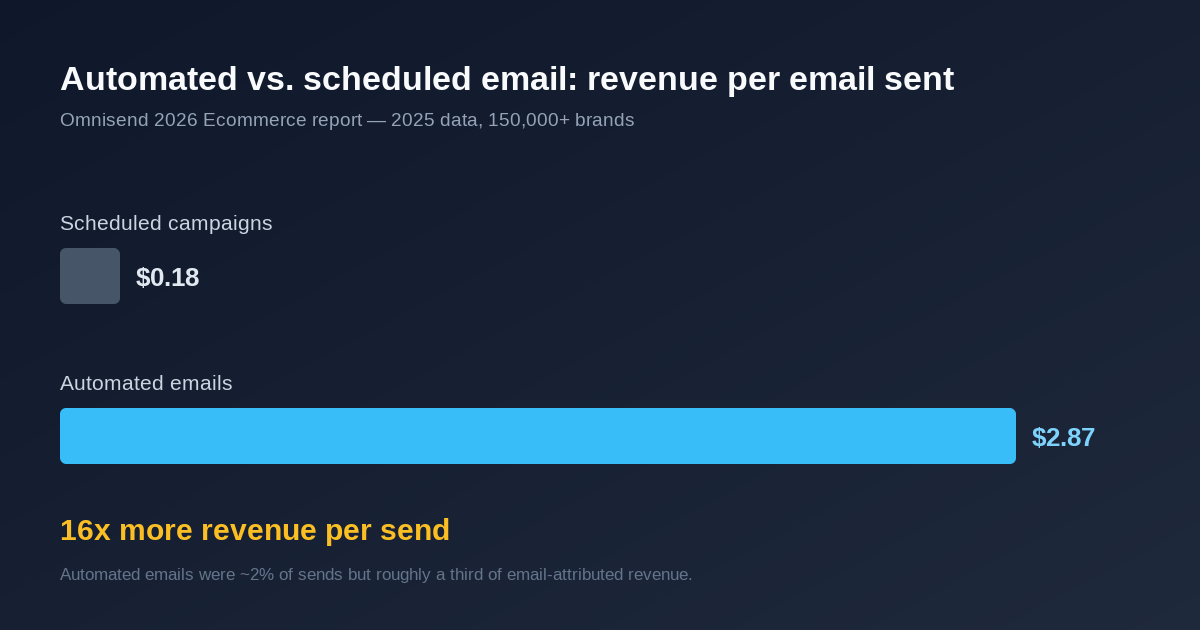
The best email marketing automation tool for most small businesses in 2026 is Brevo or MailerLite if you're under $50/month, Omnisend if you run an ecommerce store, ActiveCampaign if you need deep sales-and-marketing automation, and Klaviyo if you're a scaling Shopify brand with a data team to feed it. Email itself returns $36 for every $1 spent — the highest ROI of any channel Litmus measures (Litmus, Jul 2025) — and automation is where that return concentrates: automated emails were just 2% of sends but drove 37% of all email revenue in Omnisend's 2026 report, earning roughly 16x more revenue per send than scheduled campaigns.
Here's the problem with choosing one, though. Most pages ranking for this topic are written by the vendors themselves — AWeber's "best" list, Sender's comparison, SalesHandy's roundup. They rank their own product first, bury the automation limitations in feature-list marketing, and almost never tell you what a tool's automation builder actually can't do before you've paid for a year of it. This guide is the opposite: an independent comparison built around real automation capability — what each tool can trigger, branch, and cap — plus honest pricing at every list size, and picks segmented by use case rather than by whoever pays the biggest affiliate commission.
Key Takeaways
- Automated emails generate about 16x more revenue per send than scheduled campaigns (Omnisend 2026: $2.87 vs. $0.18 per email) — the automation builder, not the template gallery, is the feature you're buying.
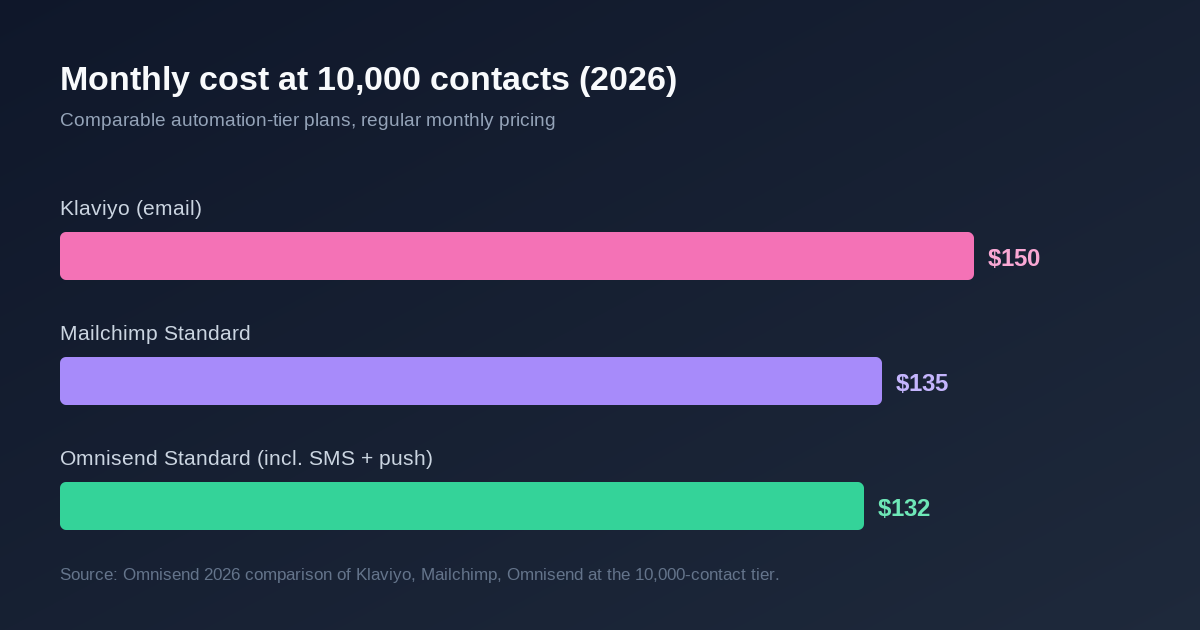
- Pricing at 10,000 contacts: Klaviyo ~$150/month, Mailchimp Standard ~$135, Omnisend Standard ~$132 with SMS and push bundled in.
- Budget tools hide the real limit in "actions per automation" — ActiveCampaign's Starter plan caps at 5 actions per automation, which constrains real sequences.
- Mailchimp counts unsubscribed and non-subscribed contacts toward your billable total; Omnisend and Klaviyo don't. List hygiene directly changes your bill.
- Best picks by use case: Brevo/MailerLite under $50/month, Omnisend for ecommerce under ~10K contacts, ActiveCampaign for B2B nurture, Klaviyo for scaling Shopify brands.
What Actually Separates These Tools: Automation Capability, Not Feature Lists
Every vendor's homepage claims "powerful automation." The differences that matter show up in four concrete questions, and you should ask all four on a trial before paying:
1. How many steps can one automation have? ActiveCampaign's Starter plan ($15–$19/month for 1,000 contacts depending on billing cycle) caps automations at 5 actions each — enough for a basic welcome email plus a tag, not enough for a real nurture sequence with delays, conditions, and branching (ActiveCampaign pricing, checked Sep 2026). Klaviyo's flow builder has no meaningful step cap and supports unlimited conditional splits based on purchase history, engagement, and predicted lifetime value. Omnisend's builder supports up to 20 trigger filters, 20 conditional splits, and four exit conditions per workflow — generous for the price.
2. Can it branch on behavior, not just opens? The useful branching is ecommerce- and CRM-aware: "did they buy product X but not Y," "predicted LTV above $200," "deal stage changed." Klaviyo and ActiveCampaign handle this natively. Brevo can branch on email engagement and page visits; deeper CRM branching is gated to higher tiers. Mailchimp's automation — and note its free plan includes no automation at all — is basic compared to all three.
3. What triggers can start a flow? Cart abandonment, browse abandonment, back-in-stock, post-purchase, win-back. Klaviyo's real-time Shopify sync streams every browse and cart event the moment it happens — the reason it's the Shopify Plus default. Omnisend covers the same core events with a solid native sync. Generic tools like MailerLite trigger on signup, date, and link click, which covers newsletters and courses but not ecommerce recovery flows.
4. How does it count contacts? This is the quiet bill-killer. Klaviyo bills on all active profiles whether you email them or not. Mailchimp counts subscribed, unsubscribed, and non-subscribed contacts until you archive or delete them — confirmed in its own pricing documentation. Omnisend excludes unsubscribed contacts. Two tools with identical sticker prices can differ 20–30% in real monthly cost depending on how dirty your list is.
That revenue-per-send gap is why the automation builder — not the template count, not the AI subject-line generator — is the feature you're actually buying. A tool that limits you to 5-action automations caps the sequences that earn 16x.
The Real 2026 Pricing, At Every List Size
Sticker prices are marketing; list-size pricing is reality. All three of the ecommerce-heavy tools are free up to roughly 250 contacts and 500 monthly sends — after that, the curves diverge hard:
| Contacts | Klaviyo (email) | Omnisend (Standard) | Mailchimp (Standard) | |---|---|---|---| | ~500 | $20 | $16 | $20 | | ~5,000 | $100 | $81 | $100 | | ~10,000 | $150 | $132 | $135 | | ~25,000 | $400 | $282 | $310 |
Source: Omnisend's 2026 comparison, based on each platform's regular monthly rates (not promotional prepay pricing).
Three pricing facts worth internalizing before you pick:
- Klaviyo's curve is the steepest. Its email plan rises 167% from $150/month at 10,000 profiles to $400 at 25,000 — and because it bills all active profiles, dead subscribers inflate that faster than revenue justifies. A 50,000-contact list runs around $700/month.
- Omnisend is cheapest at every tier and bundles SMS and web push into plans where Klaviyo charges an SMS add-on on top. At 25,000 contacts the gap is roughly $118/month, about $1,400/year.
- Mailchimp's entry price is lowest ($13/month Essentials) but gates the features you came for. Predictive segmentation, customer lifetime value, and advanced segmentation sit on Standard and above; its free plan has no automation, and transactional emails (order confirmations, receipts) bill separately from the marketing plan.
On the non-ecommerce side: Brevo prices by emails sent rather than contacts — Starter starts at $9/month for 5,000 emails and climbs to $82 for 100,000, with the full-automation Standard tier from $18/month. MailerLite's free tier allows 12,000 emails/month to 1,000 subscribers, the most generous free automation in the category, with paid plans from about $10–19/month at small list sizes. ActiveCampaign starts at $15–19/month for 1,000 contacts (annual vs. monthly billing) and is priced by contact count like Klaviyo.
For context on what a properly-run automated email program earns back, Klaviyo's 2026 benchmarks across 183,000+ accounts put average flow open rates at 32.2% and top-10% accounts at 45.8% (Klaviyo benchmarks, Feb 2026) — and MailerLite's 3.6-million-campaign dataset reports a 43.46% median open rate, though Apple Mail Privacy Protection inflates these figures; Litmus tracked Apple clients accounting for 76.56% of opens as of September 2026, so treat open rate as directional and judge your program on revenue per email instead.
Best Email Marketing Automation Tools by Use Case
Best under $50/month for small business: Brevo or MailerLite
At small list sizes both are cheaper than anything ecommerce-first, and both include real visual automation builders on entry paid tiers. MailerLite's free plan (12,000 emails/month) means you can run a functioning welcome sequence before paying anything. Brevo's send-based pricing suits irregular senders — you pay for volume, not list size, so a slow-growth B2B list stays cheap for years. The tradeoff: neither has ecommerce-grade event tracking or revenue attribution.
Best for ecommerce under ~10,000 contacts: Omnisend
For a DTC store doing under $50K/month, Omnisend delivers most of what Klaviyo does at a lower price with SMS bundled — its cross-channel flows (email, wait 2 hours, SMS if unopened) work without a second vendor, and 24/7 support comes on every plan including free. Its builder's 20-conditional-split ceiling is only a problem at scale.
Best for B2B and SaaS nurture: ActiveCampaign
The deepest CRM-linked automation in this price class: lead scoring, deal-stage triggers, site tracking, and split-action branching that generic tools can't express. It's also the tool most punished by picking the wrong tier — budget for Plus ($49+/month), not Starter, or the 5-action automation cap will strangle your sequences. Skip it if you have no sales process to automate; it's overkill for a newsletter business.
Best for scaling Shopify brands: Klaviyo
The premium buys the best real-time Shopify sync in the category, predictive CLV and churn-risk scoring, and the most powerful flow builder available. It's the right call once email is a proven revenue channel and you have someone who will actually use the segmentation depth — Shopify holds an equity stake and Klaviyo is the recommended Plus partner for a reason. Below roughly $30K/month store revenue, that depth usually goes unused, and Omnisend's price is the smarter buy.
Best for newsletters and simple campaigns: Mailchimp — with caveats
Mailchimp remains fine for non-ecommerce senders who want one familiar tool. But its automation is basic, its free plan excludes automation entirely, and its contact-counting policy (unsubscribed contacts bill until archived) makes it the most expensive "cheap" option for an unhygiened list. If you're building a real retention program, it's the wrong foundation — as our digital marketing agency pricing guide notes for budgeting generally, the sticker number is rarely the whole bill.
The Five Automations Worth Building First
Whichever tool you pick, the money is in the same five flows — welcome, abandoned cart, browse abandonment, post-purchase, and win-back account for 88% of all automated email orders per Omnisend's 2026 data. Welcome emails average an 83.6% open rate (the highest of any email type), abandoned-cart emails average 50.5% opens with a 3.33% conversion rate per Klaviyo's benchmarks, and sending three cart-recovery emails produces 69% more orders than one. Build the welcome series and abandoned-cart flow in week one; most tools ship both as pre-built templates you can launch the same day.
One measurement rule before you launch: judge the program on revenue per email, not opens. Omnisend's 2026 data puts automated emails at $2.87 per email against $0.18 for scheduled campaigns across 150,000+ brands — if your flows earn clearly more per send than your campaigns and keep improving, the tool is working regardless of what the open-rate column says.
How to Choose in One Trial Weekend
Sign up for two trials on Friday, build the same welcome flow in both, and pick using this sequence: (1) does the automation builder let you build the branching your business actually needs at your tier, (2) what does the tool cost at the contact count you'll have in 12 months, given its contact-counting policy, (3) does it natively connect to your store or CRM. Price the list you'll have next year, not today's — every contact-based tool in this guide punishes you for growing faster than you planned.
If you'd rather have a partner set up and run the flows — tool selection, sequence copywriting, and revenue tracking — see SparkSphear's digital marketing services, or start with what AI automation can do for a small business before committing to any platform.
Frequently Asked Questions
What is the best email marketing automation tool in 2026?
For most small businesses: Brevo or MailerLite under $50/month, Omnisend for ecommerce stores, ActiveCampaign for B2B sales-and-marketing automation, and Klaviyo for scaling Shopify brands. The right pick depends on your list size, your store or CRM, and whether the automation builder's limits on your chosen tier fit the sequences you need.
How much do email marketing automation tools cost?
Entry paid plans run $9–$20/month, but real cost scales with list size: at 10,000 contacts expect roughly $132–$150/month for Omnisend, Mailchimp Standard, or Klaviyo email; at 25,000 contacts, $282–$400/month. Free tiers (MailerLite, Brevo, Omnisend, Klaviyo) cover roughly 250–1,000 contacts with 500–12,000 monthly sends.
Are free email automation tools good enough to start with?
Yes, for launching. MailerLite's free tier (12,000 emails/month) and Omnisend's free plan (full automation workflows, 24/7 support) both run genuine welcome and recovery sequences. The limits — small contact caps and no removal of platform branding — matter only once your list grows past a few hundred engaged subscribers.
Do automated emails really outperform regular campaigns?
Consistently, and by a wide margin. Automated emails made up about 2% of send volume but drove 37% of email revenue in Omnisend's 2026 report (150,000+ brands), earning roughly 16x more per email than scheduled campaigns ($2.87 vs. $0.18). Welcome and abandoned-cart emails are the strongest performers, with 83.6% and 50.5% average open rates respectively.
Want these results for your AI & Automation?
We build custom AI agents and workflow automations tailored to your exact operations. Stop losing money to manual work.